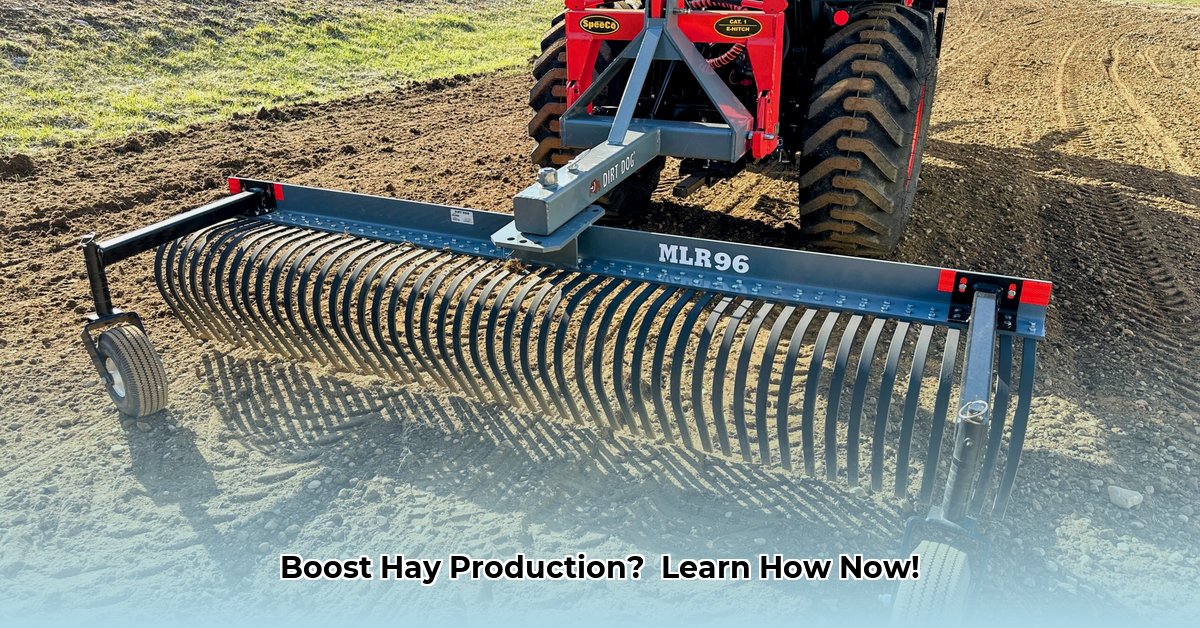
Haying is hard work, but a pull-behind tractor rake can significantly boost efficiency and reduce labor. This guide will help you choose, operate, and maintain a rake, while also incorporating sustainable practices for a thriving and environmentally conscious farm. For more on tractor attachments, check out this helpful resource on tractor attachments.
Choosing the Right Pull-Behind Tractor Rake
Selecting the right rake depends on several key factors:
Tractor Compatibility: Ensure your tractor has sufficient horsepower to handle the rake's demands. Consult your tractor's manual for towing capacity specifications. Underpowering the rake leads to poor performance and potential equipment damage.
Hay Type and Condition: Different rakes are designed for varying hay types (e.g., alfalfa, grass) and conditions (wet, dry, tangled). Consider this carefully; a rake optimal for light alfalfa may struggle with dense, heavy grass.
Field Characteristics: For smaller, level fields, a smaller, more maneuverable rake will suffice. Larger fields or uneven terrain require a sturdier, more robust model capable of handling challenging conditions. Difficult topography necessitates a more powerful machine.
Budgetary Constraints: Pull-behind rakes are available at a wide range of price points. Establish a budget beforehand to prevent impulsive purchases and ensure a financially responsible decision.
Understanding Pull-Behind Tractor Rakes
Most rakes use rotating tynes (teeth) to gather and arrange hay into windrows (neat rows). The efficiency of this process hinges on several key design features:
Wheel Design: Wheel size and configuration affect maneuverability and ground clearance. Larger wheels provide better ground clearance on uneven terrain, while smaller wheels increase maneuverability in tight spaces.
Tyne Spacing and Design: Tyne spacing significantly impacts hay handling. Closer spacing is ideal for lighter crops to minimize loss, while wider spacing is suitable for heavy grasses. Careful consideration of your hay type will determine which configuration best suits your needs.
Windrow Formation: Consistent, well-shaped windrows are crucial for efficient baling. Poor windrow formation increases hay loss and complicates the baling process. A properly functioning rake will produce even, consistent lines for optimal harvesting.
Operating Your Pull-Behind Tractor Rake: A Step-by-Step Guide
Efficient operation maximizes your hay harvest. Follow these steps:
Secure Attachment: Carefully attach the rake to your tractor's three-point hitch, ensuring a secure and stable connection. Double-check all connections to prevent accidents.
Precise Adjustment: Adjust the rake's settings (tine height, windrow width) according to your hay type, field conditions, and the rake's specifications. Your manual provides crucial guidance for this step.
Consistent Raking Technique: Maintain a steady speed during raking, avoiding both excessive speed (leading to missed hay) and excessive slowness (reducing efficiency). Overlapping passes ensures thorough coverage.
Regular Maintenance: Regular maintenance, including lubrication and inspection for wear and tear, prolongs the rake's lifespan and ensures optimal performance. This includes checking for loose bolts, damaged tynes, and smooth wheel rotation. Preventative maintenance reduces the risk of costly breakdowns.
Weighing the Pros and Cons
Before investing, consider the advantages and disadvantages:
| Advantages | Disadvantages |
|---|---|
| Increased Efficiency | Higher initial investment |
| Reduced Labor | Requires a suitable tractor |
| Consistent Windrows | May struggle in extremely rough terrain |
| Improved Hay Quality | Requires proper operation and maintenance |
| Reduced Physical Strain |
Sustainable Hay Production: Beyond the Machine
Integrating sustainable practices maximizes your harvest's efficiency and environmental impact:
Soil Health: Maintain soil health through proper fertilization and weed control, avoiding overuse of chemicals. Soil testing informs precisely timed and correctly balanced fertilization to maximize yields while minimizing environmental impact.
Crop Rotation: Rotate crops to improve soil health and reduce the risk of nutrient depletion. Strategic crop planning promotes long-term soil fertility and enhances your hay production.
Water Management: Efficient irrigation practices conserve water and prevent waterlogging, which can damage hay quality. Precise irrigation methods minimize water waste and environmental impact.
"Implementing sustainable practices isn't merely an environmental responsibility; it's a crucial factor in long-term farm profitability," says Dr. Emily Carter, Agricultural Sustainability Expert at the University of California, Davis.
Minimizing the Environmental Impact
Consider these strategies for minimizing the environmental impact of your equipment:
Optimize Passes: Minimize overlapping passes to reduce fuel consumption and soil compaction. Efficient route planning drastically minimizes unnecessary passes across the field.
Proper Tire Inflation: Maintain correct tire pressure to prevent soil compaction and damage. Under-inflation compacts soil, while over-inflation leads to damage.
Fuel Efficiency: Consider using biodiesel as a more sustainable fuel option that reduces greenhouse gas emissions. While alternative fuels are being developed, biodiesel offers a relatively low-risk and accessible option for reducing the impact of your equipment.
Precision Agriculture: Implement GPS-guided systems for optimized raking patterns, minimizing fuel consumption and soil compaction. The initial investment in precision technology results in long-term cost savings through better efficiency.
Soil Health: Implement no-till practices and utilize cover crops to mitigate the effects of soil compaction and enhance long-term soil health. These sustainable practices balance the need for effective hay production with environmental protection.
Remember, a pull-behind rake is a vital tool for efficient hay production, but its effectiveness is amplified by smart, sustainable farming practices. A holistic approach combines equipment efficiency with environmental consciousness for a profitable and environmentally responsible operation.